
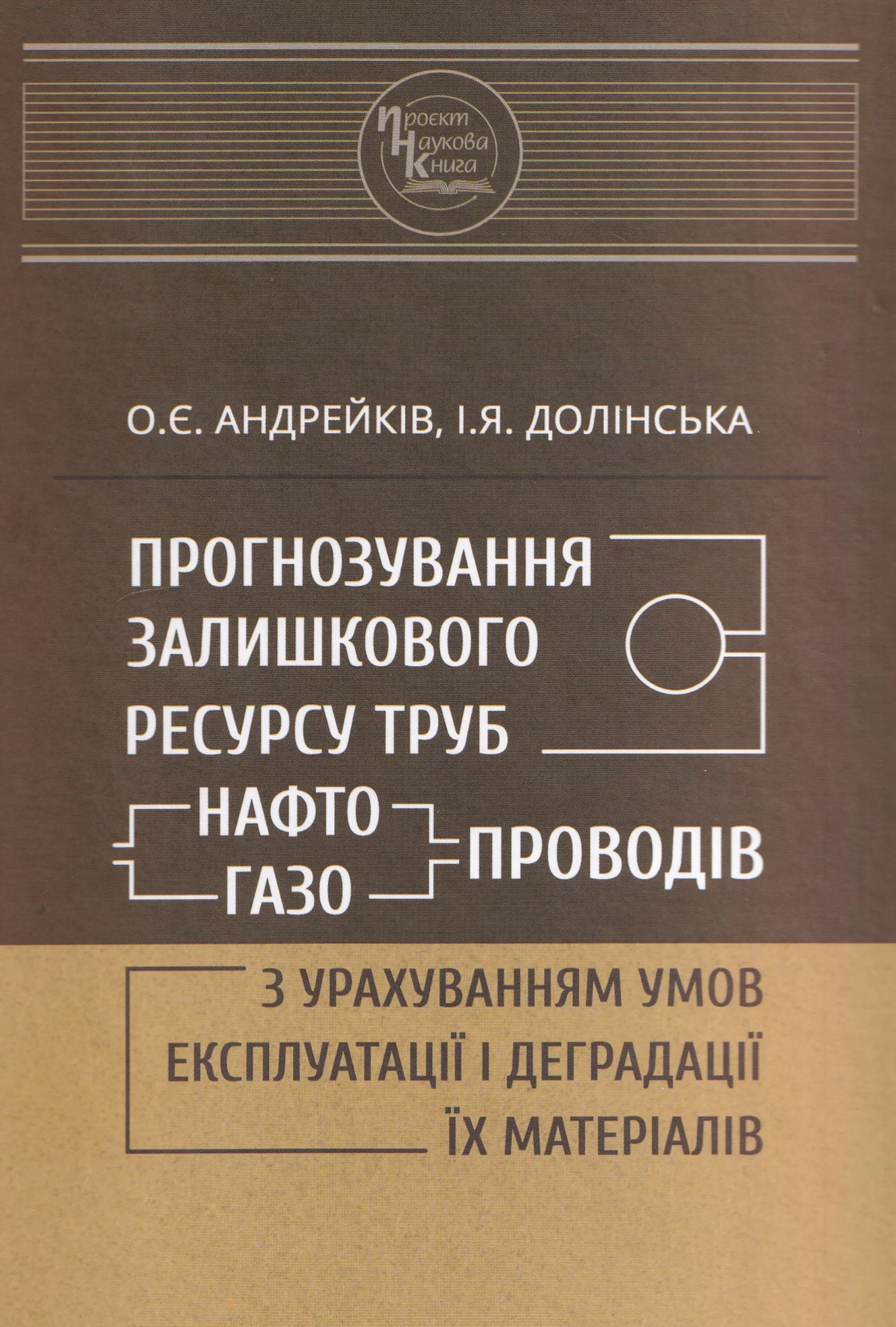
Prediction of the residual lifetime of oil and gas pipeline pipes, taking into account the operating conditions and degradation of their materials
Type of periodical: Monographies
Publication types: Printed edition
Section: Materials science
Publication date: 2023
Authors: Oleksandr Andreykiv , Iryna Dolinska
Summary: The monograph considers the issue of forecasting the lifetime (residual lifetime) of oil and gas pipeline pipes, taking into account the conditions of operation and degradation of their materials. The condition of operated oil and gas pipelines was analyzed. The conditions and modes of operation are described, as well as their influence on the damage and defects of main oil and gas pipelines. Approaches to the approximate determination of deformation, force and fatigue parameters in oil and gas pipelines are presented. The methods of diagnosing the state of materials of oil and gas pipelines and their welded joints have been developed. In particular, methods of non-destructive testing for determining the size of cracks in structural elements, parameters of the stress-strain state, residual stresses in welded joints. Based on the energy approach and the deformation approach, mathematical models (differential equations with initial and final conditions) for study the kinetics of propagation of surface defects such as cracks in oil and gas pipelines and their welded joints have been built. Methods have been developed for estimating the residual life of oil and gas pipelines under different modes of force loading (static, cyclic, maneuvering (repeated hydraulic shocks, closing-opening of shutters, oil flow turbulence etc)), the action of physical and chemical factors (soil corrosion, hydrogen-containing environment) and the degradation of their materials during operation. The application of the methods is demonstrated on specific examples of calculating the residual lifetime of problematic sections of pipes of oil and gas pipelines of Ukraine. A general approach for determining the lifetime of oil and gas pipeline pipes is formulated, taking into account periods of local chemical corrosion (formation of corrosion caverns and pitting), initiation of corrosion-mechanical cracks near corrosion caverns and pitting, subcritical growth of corrosion-mechanical cracks.
Reading audience: For a wide range of specialists – mechanics, material scientists, research engineers working in the field of predicting the lifetime of structural elements, in particular oil and gas pipelines, as well as students and postgraduates who specialize in this field.
ISBN ISBN 978-966-00-1852-5
Book project: Scientific book
Responsible institutions: Karpenko Physico-Mechanical Institute of NAS of Ukraine
Published: Kyiv
Size in pages: 268
Print run: 50
 English
  Ukrainian