
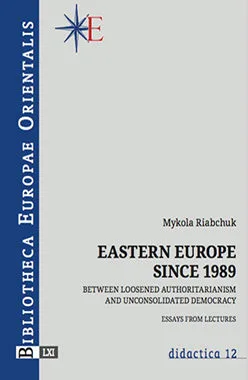
Eastern Europe since 1989: Between the Loosened Authoritarianism and Unconsolidated Democracy : Essays from lectures
Type of periodical: Monographies
Publication types: Printed edition
Section: Politology
Publication date: 2020
Editors: M. Riabchuk
Summary: The book examines political processes in Eastern Europe after the fall of the communist system and collapse of the Soviet empire in 1989-1991. It explores the structural factors that determined different development of the postcommunist states and the role of domestic and international actors that influenced the direction and speed and scope of their transformations. While the author keeps all the East Europe in mind, from the Baltic to Adriatic and the Black Sea, the main focus is on the post-Soviet part of the Eastern Europe, the so-called «Western New Independent States» (a.k.a. «New Eastern Europe»), and specifically on Ukraine as the most complicated, ambivalent, and graphical case of both the decommunization and decolonization processes. The process tracing is combined with political analysis of historical developments in the postcommunist Eastern Europe drawn primarily on the theories of hybrid regimes, illiberal democracies, path-dependence and revolutionary breakthroughs.
Reading audience: The book is supposed to be of some use for historians, political scientists, experts, policy makers and anybody interested in contemporary Eastern Europe.
ISBN 978-83-61325-88-8
Available at: https://www.academia.edu/44806772/Eastern_Europe_Since_1989_Between_Loosened_Authoritarianism_and_Unconsolidated_Democracy_contents_intro_
Responsible institutions: Kuras Institute of Political and Ethnic Studies of NAS of Ukraine
Published: Warszawa : Studium Europy Wschodniej
Size in pages: 208
Print run: 2000